
Do Flight Protectors Help—or Just Change Your Setup?
They hold folding flights square and may redirect some incoming points, but evidence does not prove better scoring, durability or long-term savings.
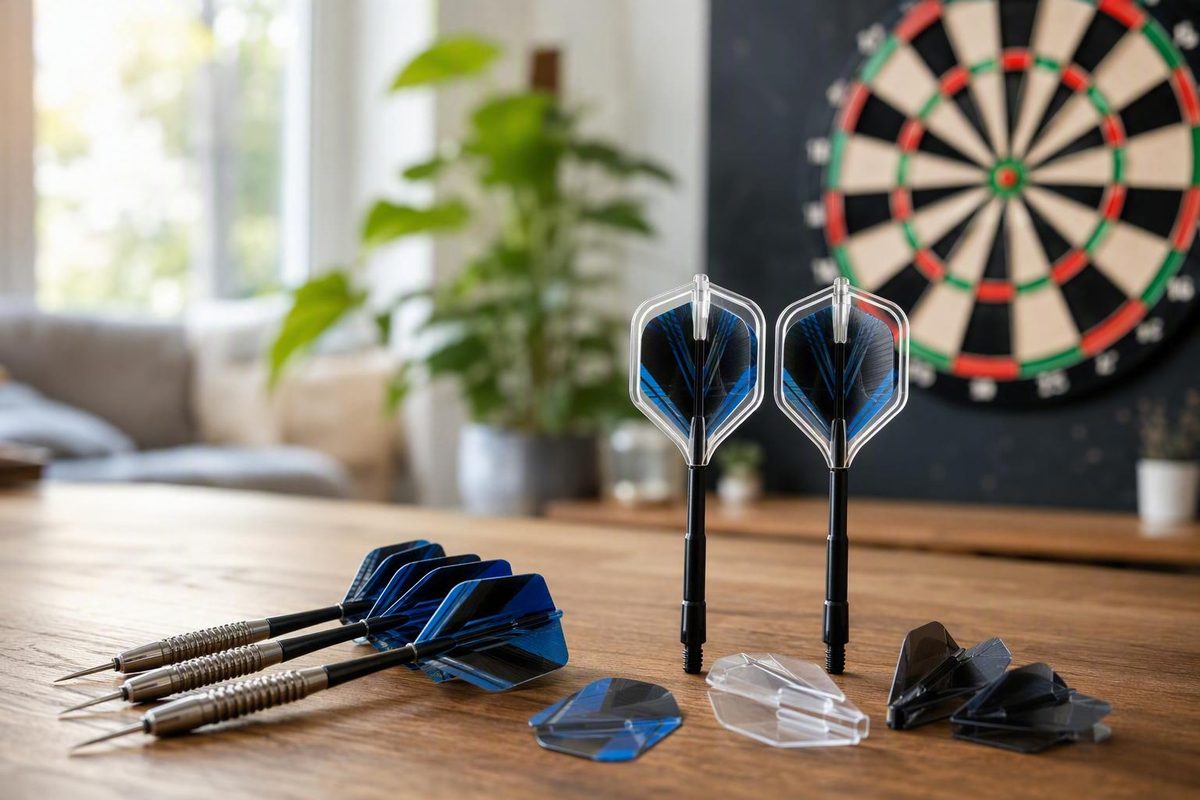
Flight protectors are worth considering when conventional folding flights repeatedly lose their square shape or suffer damage along the rear edge. Their clearest practical role is holding the flight panels evenly spread; they may also redirect some incoming points. They are not essential, however, and the manufacturer, retailer and community sources cited below do not provide controlled comparisons showing improved accuracy, scoring, durability or long-term savings. If your current setup is reliable—or you use molded or integrated flights—leaving them off is entirely reasonable.
The short answer: useful for some folding-flight setups, not essential
Start with a specific problem, then judge the protector against it on your own darts.
| Setup or problem | Likely value | Reason |
|---|---|---|
| Folding flights with repeated rear-edge damage | Possibly useful | The cap may redirect some incoming points |
| Flights that repeatedly lose their square shape | Possibly useful | The protector holds the panels in alignment |
| Molded or integrated flight system | Usually unnecessary | The system already retains its intended shape |
| High sensitivity to setup changes | Test cautiously | The cap adds material at the rear |
| Cheap flights with little visible damage | Probably unnecessary | Replacement may be simpler than another accessory |
Shape retention is the strongest recurring reason players give for keeping protectors fitted. Reports about longer flight life, better scoring or lower costs are much less certain. A Darts Nutz discussion about flight protectors records mixed experiences: some players value the support and rear-edge protection, while others find the caps fiddly or unnecessary.
Do not add them solely because a retailer recommends them or another player uses them. Decide what success means—fewer straightening stops, fewer damaged flights or no unwanted change in feel—and record whether the accessory delivers it.
What a dart flight protector actually does
A flight protector is a small nylon, plastic, aluminum or other metal cap fitted over the exposed rear edges of a conventional folding flight. Before installation, the flight panels should be spread evenly at approximately 90 degrees. The protector then sits over the end and holds those edges in alignment, as described in Harrows’ flight-fitting and accessory guidance.
Protectors generally have a groove for each panel. Once the panels are evenly spread, each one slides into its corresponding groove so the cap sits centrally across the rear of the flight.
A protector should not be confused with other rear-of-dart components:
- Flight protector: covers the exposed rear edge of a folding flight.
- Shaft ring: helps a conventional shaft grip and retain the flight.
- Molded flight: arrives in a fixed three-dimensional shape.
- Integrated system: combines the flight and shaft in one assembly.
A protector does not secure every part of the dart or convert a folding flight into an integrated system. It is an optional cap, not a required component.
Pros: shape retention and possible impact protection
The clearest benefit is mechanical rather than aerodynamic: a protector keeps the panels evenly spread. If a folding flight tends to flatten in a case, close between visits or become asymmetrical during play, the cap provides a fixed point that holds the rear edges square.
That can be useful without assuming any improvement in accuracy. A player may simply prefer not to reshape the flight before every visit, particularly when using thin folding flights that move easily.
The second intended benefit is impact protection. When an incoming dart approaches the rear of a dart already in the board, the protector presents a reinforced edge. Retailers consequently promote protectors as a way to reduce splits, tears, pierced flights and deformation.
That mechanism may help during some “Robin Hood” contacts. In darts, a Robin Hood occurs when an incoming dart strikes or embeds in the flight or shaft assembly of a dart already in the board.
Claims about longer flight life and lower replacement costs should remain claims rather than guarantees. The cited retailer sources describe those benefits, while player reports include both positive and indifferent experiences; they do not quantify how often a protector successfully redirects a point or how much longer a flight lasts.
Protectors are marketed as inexpensive accessories, but a low initial price does not establish long-term value. A player who rarely damages cheap flights may save nothing. Someone repeatedly replacing more costly folding flights has a stronger reason to test them, but still needs to count replacements rather than assume a saving.
Cons: added rear mass, fitting problems, and scoring trade-offs
Adding a protector necessarily puts more material at the rear of the dart. The cited forum and retailer sources do not establish a representative weight across different nylon and metal products, nor a universal effect across complete dart setups.
Players in the Darts Nutz discussion disagree about whether the change is noticeable. Reported possibilities include a different balance, trajectory, board-entry angle or general feel, but these are setup-specific observations rather than measured performance effects. A player with a familiar, finely tuned setup may notice a change that another player does not.
Protection and scoring must also be judged separately. The cited sources do not quantify how frequently such deflections occur or their net scoring effect.
Fit creates more immediate and observable problems. A protector may:
- be awkward to align across the thin panels;
- loosen or fall off during play;
- grip a thin flight poorly;
- sit off-centre and leave one edge exposed;
- pinch, crease or split a panel if forced into place;
- crack or break, particularly in some nylon versions.
Retailer guidance identifies loose caps, poor grip, cracking and damage from off-centre fitting as possible drawbacks. It also presents nylon and metal as different compromises rather than equivalent products in the MoreSports flight-protector guide.
This does not establish that protectors commonly cause bounce-outs, reduce accuracy or worsen grouping. The narrower conclusion is that they introduce another fitted component and another contact surface, so poor fit or a collision can produce a different outcome from an unprotected flight.
Nylon versus metal—and which flight systems need neither
Retailers generally position nylon or plastic and metal protectors as follows:
| Material | Typical retailer positioning | Potential advantage | Potential drawback |
|---|---|---|---|
| Nylon or plastic | Lighter, cheaper general-use option | Less concern about added rear material | May crack or wear under repeated impacts |
| Aluminum or other metal | More impact-resistant option | Marketed for repeated direct contact | May cost more and add slightly more rear material |
These are product-positioning claims, not results from comparative durability testing. Neither material is universally better.
Nylon may be a reasonable first trial for somebody mainly interested in holding flights square. Anyone sensitive to changes at the rear of the dart should compare the options rather than treating the material difference as irrelevant.
Fit can vary within either category. Flight thickness, profile and edge construction differ, as do protector groove dimensions. Labels such as “universal” should not be read as a guarantee of compatibility with every flight.
Separate protectors are mainly intended for conventional folding flights. Many molded flights already hold a fixed shape, while integrated flight-and-shaft systems form a complete rear assembly. Those configurations generally do not need—and may not accept—a separate cap.
Check the exact flight system before buying. A replaceable molded flight, a folding flight mounted in a conventional shaft and a one-piece integrated system are different configurations even when they have a similar overall outline.
How to fit one—and run a measurable comparison
- Fit the folding flight fully into the shaft.
- Spread the panels evenly into their intended square arrangement.
- Align each panel with one groove in the protector.
- Centre the cap over the complete rear edge.
- Press it down until it sits flush and level.
- Confirm that it is secure and is not pinching, splitting or distorting any panel.
Check each cap before a session. Remove or replace it if it loosens, cracks or pulls the flight out of shape. A protector that repeatedly needs to be forced back into position is not a reliable fit for that flight.
Once fitted, compare results rather than judging the first few throws. Use otherwise identical barrels, shafts and flight models. Ideally, prepare two matched sets: one with protectors and one without. Play equal blocks of three-dart visits or complete 501 legs, alternating which setup goes first to reduce the influence of warming up or tiring.
| Measure | Without protectors | With protectors | Notes |
|---|---|---|---|
| Visits or legs played | Keep the sample equal | ||
| New flight tears | Count visible damage only | ||
| Loss of square shape | Use one consistent definition | ||
| Protector failures | N/A | Record cracks or detachments | |
| Obvious rear impacts | Note whether damage followed | ||
| Deflections or bounce-outs | Record clearly observed events | ||
| Three-dart average | Compare blocks, not one visit | ||
| Entry angle or feel | Use brief, consistent notes |
It can show whether protectors stay attached, whether flights need less straightening and whether the modified setup feels unfamiliar in your normal throw.
Define success before starting. If shape retention is the goal, count how often each flight needs adjustment. If durability is the goal, record how many comparable sessions each set survives. Do not make the decision from one unusually high or low scoring session.
Do professional players use flight protectors?
Professional adoption does not settle the question. A community claim that no tour-card holder uses protectors has been disputed by commenters suggesting possible counterexamples, but those recollections are not verified equipment or adoption data. The disagreement is visible in the discussion about tour-card players and flight protectors.
It would therefore be misleading to publish a definitive list of professional users or claim that professionals generally reject the accessory. A professional’s preferred rear assembly also does not establish what will work for a pub or league player whose folding flights repeatedly flatten or split.
Use compatibility, wear and recorded results instead. If protectors solve the problem you defined without creating recurring fit failures or an unwanted change in feel, keep them. If the tracked comparison shows no practical benefit—or you already have a reliable molded, integrated or unprotected setup—leave them off.