
Soft Tip Darts: Get Set Up and Measure Your Scoring
Choose suitable soft tip darts, check board distance and scoring rules, then use a repeatable 60-dart test to compare bull and treble-20 scoring.
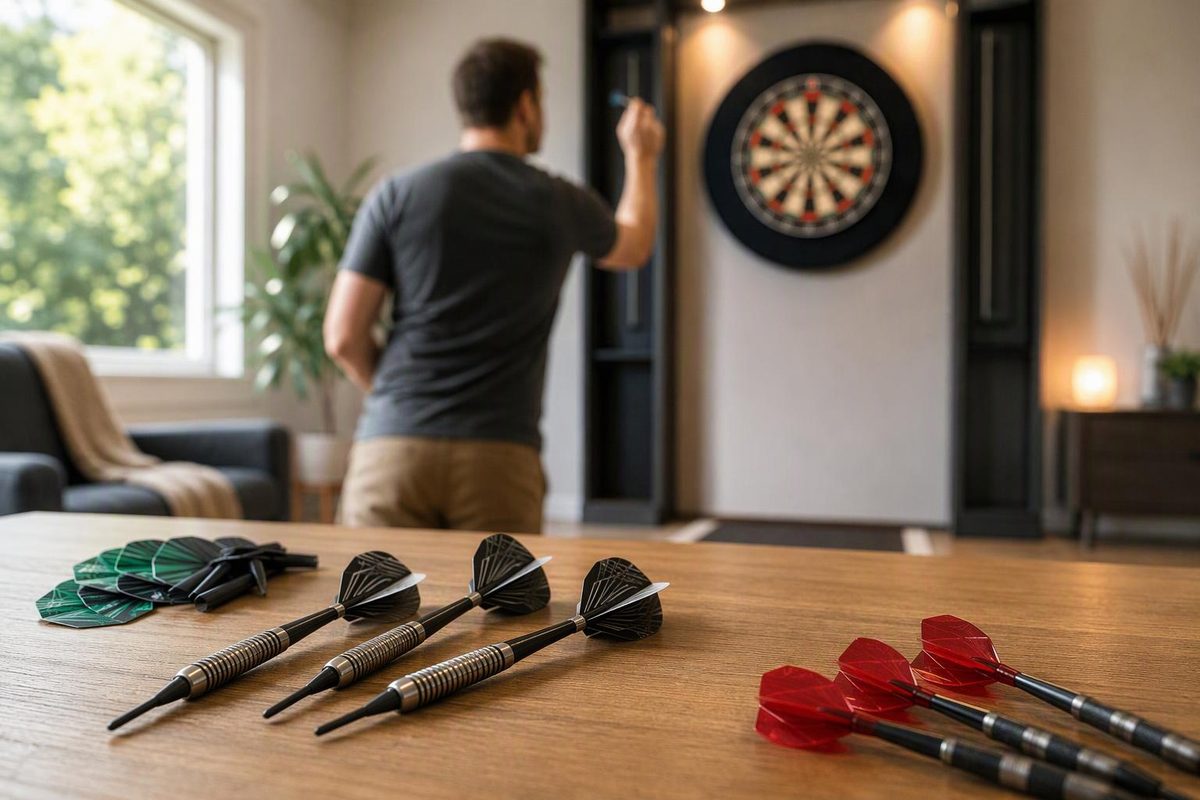
Soft tip darts use plastic points for electronic dartboards. The machine records the score, but the equipment limits, bull value and finishing rules still need checking before you play. The National Dart Association’s rules, for example, specify plastic-tip darts and different bull settings for different games.
Start with a suitable set and the correct throw line, then record a short scoring test. You do not need to find a supposedly perfect dart before you can practise usefully.
Choose darts that fit the board—and your grip
Before buying, check three things:
- The board’s equipment requirements. Follow its instructions for permitted darts and maximum weight, as well as your competition’s rules.
- The weight of the complete dart. Check whether the advertised figure refers to the barrel or the assembled dart. If you are close to a competition limit, weigh it with the tip, shaft and flight fitted.
- Replacement-tip compatibility. Buy spare tips specified to fit your barrels rather than assuming every plastic point fits.
Weight limits are not universal. The NDA permits a maximum of 20g per complete dart, including every component. THE WORLD permits 25g total per dart. A dart legal for one competition may therefore be unsuitable for another. These are the NDA and THE WORLD rules available as of October 2026.
For your first set, prioritise a barrel you can locate comfortably in your fingers without repeatedly adjusting it. If house darts are available, use them to establish what feels manageable before buying. DARTSLIVE’s equipment guide recommends choosing a barrel to suit your grip and throw, checking for bent tips and carrying spares because tips can break.
Keep that first setup unchanged while you establish a baseline. If you later test a different barrel or grip, use a one-change comparison rather than replacing everything at once.
Set the throw line for your format
For NDA play, the bull centre is 5 ft 8 in (1.73m) above the floor, and the horizontal distance is 8 ft (2.4384m) from the board face to the front edge of the foul line. Measure from the target face—not the cabinet or the wall. Those dimensions come directly from the NDA specifications.
If you play under another organiser, use its setup requirements. Do not automatically carry over your steel-tip line. Our steel-tip versus soft-tip distance guide explains the measurement points.
Mark a repeatable foot position behind the line for practice. The aim is to remove setup uncertainty before judging your throwing accuracy.
Check the game settings before choosing targets
Singles score the numbered value, doubles twice that value and trebles three times it. Treble 20 is worth 60, but the bull value depends on the format. DARTSLIVE’s scoring guide explains the numbered segments and why players may choose the larger bull target despite treble 20’s higher value.
Two settings matter especially:
- Full bull or split bull: NDA open-in/open-out ’01 uses a full bull worth 50. Its Masters ’01 double-in/double-out events use a 25/50 split bull, as does its Cricket format.
- Finishing requirement: NDA’s general ’01 format is any-in/any-out, while its Masters ’01 double-in/double-out events require doubles to start and finish. Check the selected mode before rehearsing checkouts. Source: NDA game rules.
Bounce-outs also need a rule check. Under NDA rules, a thrown dart consumes an attempt even if it bounces out without scoring; you cannot throw it again. A bounce-out that registers can still count. Do not assume that rule applies unchanged to every machine or event. Follow the organiser’s scoring and correction procedure, and query errors before removing darts. Source: NDA scoring rules.
Run a 60-dart scoring test
This is a solo practice comparison, not a rating calculation or a checkout test. Use the same board, darts, distance and bull setting each time.
Setup: Warm up briefly, then prepare two rows in a notebook: “bull” and “treble 20”.
Action: Throw ten three-dart visits at the bull and ten at treble 20. Alternate targets after each visit. For each target’s 30 darts, record:
- Total points from all darts, including misses.
- Hits in the intended target: bull hits or treble-20 hits. For split bull, record inner and outer hits separately.
- Bounce-outs and any scoring errors separately.
Count every released dart as one of the 60 attempts; do not rethrow bounce-outs. For this test, retain a bounce-out’s registered score, or record zero if it does not register. Check darts still in the board before removing them and use their actual segment values in your notebook if the machine misreads them. Correct the machine where permitted, but use the notebook totals for the comparison. These are your solo test conventions, not a substitute for competition rules.
Use one mechanical cue: let your throwing arm continue towards the target after release. DARTSLIVE describes this in its follow-through guidance. Do not deliberately punch the dart harder to make it stick.
Checkpoint: Divide each target’s total by ten to get points per three-dart visit. Repeat on two more days, starting with treble 20 on the second day. Add the three sessions’ bull totals and divide by 30 visits; do the same for treble 20. Compare these results—not just the best session—to identify which target currently gives you more points under those settings. A small difference is a reason to keep testing, not to declare a permanent winner.
Keep those results separate from steel-tip averages or tests using a different bull value. Your useful baseline is the one you can reproduce.