
6 Dart Tips for a More Repeatable Throw and Better Practice
Use six practical dart tips and a short scored session to check your stance, throw, scoring, doubles and checkout decisions.
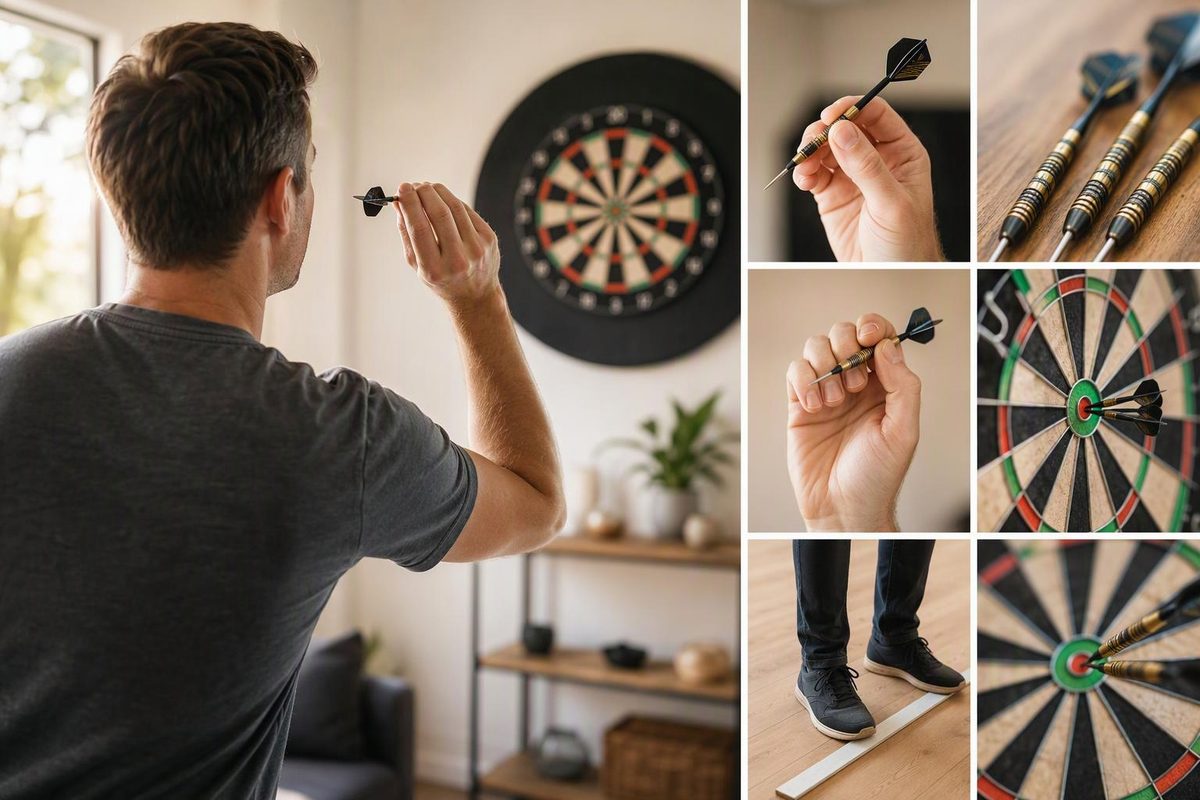
The most useful dart tips give you something specific to do—and a result you can check. Start with a stable stance, a grip that controls the dart without squeezing, and one clear target. Then test scoring and finishing separately rather than judging your whole game by the occasional 180.
Use these six tips in order. The practice blocks below form a short session of up to 90 recorded darts, after your warm-up.
1. Make your starting position repeatable
First, check the board. For standard steel-tip play, the bull centre should be 1.73 m above the floor, with the throwing distance measured horizontally from the board face to the back of the raised oche—the side where you stand—at 2.37 m. These are the dimensions in the DRA playing rules. For measuring instructions, use our dartboard setup guide.
Choose a comfortable foot angle and note where both feet sit. You do not need to copy a professional’s side-on stance. Double Top’s stance guidance emphasises individual comfort and avoiding a forward lunge during the throw.
Checkpoint: film one three-dart visit from the side, with the camera outside the throwing path. Does your torso move towards the board as you release? If so, test a less stretched stance rather than leaning farther forward.
2. Use one mechanical cue, not a checklist
Try “hold securely, without squeezing” if your grip feels tense. In his technique guidance for Shot Darts, Raymond Smith recommends only enough grip pressure to control the dart and stresses a consistent, controlled release and follow-through.
That does not mean forcing a particular finger count or copying someone else’s arm extension. Keep your comfortable grip position while testing pressure alone.
Alternatively, if your grip already feels comfortable, use one cue such as “finish the arm movement smoothly.” Do not consciously rebuild your stance, elbow, wrist and fingers on every dart.
Checkpoint: choose a cue you can describe and observe. Keep it unchanged for the recorded session; assess it afterwards, not between every throw. If you are considering a bigger alteration, follow the guide to testing a grip change.
3. Pick a precise target and keep it for the visit
Before raising the dart, select the part of the bed you want to hit—not just “somewhere in the 20.” For example, choose the centre of treble 20, the narrow inner scoring ring in that segment.
For this test, keep the same intended target throughout each three-dart visit. If the first dart misses left, record the miss rather than immediately changing your feet and grip. You are trying to observe a pattern, not explain every individual dart.
A blocked target is different: choose another visible point or a sensible alternative scoring target. In the scoring block below, note any deliberate switches so they are not confused with misses.
4. Give scoring practice a fixed endpoint
After an unscored warm-up, throw 30 darts: ten three-dart visits aimed at treble 20.
Record:
- The actual score of each visit, including points scored elsewhere.
- How many darts land anywhere in the 20 segment: single, double or treble.
- Any deliberate target switches.
Your three-dart scoring average for this block is total points ÷ 10. A total of 450 gives an average of 45.0. Count bounce-outs as darts thrown with zero points; do not replace them, in line with the DRA rules.
Keep the segment-hit count too. It distinguishes finding the correct wedge from catching the treble. Compare both figures across repeated blocks with similar target choices; one high visit is not enough to establish a trend.
5. Separate double accuracy from finishing
Throw ten darts each at D20, D16 and D8. “D” means double: the narrow outer scoring ring.
Aim every dart at its assigned double, even after a hit. This is a target drill, not a leg, so an inside single does not change the next target.
Record each result out of ten and the combined result out of 30. Six hits from 30 darts is a 20% target-hit rate, not a match checkout percentage.
Now test finishing separately. In standard double-out 501, a checkout must reduce the remainder to exactly zero on a double. Overscoring, leaving one, or reaching zero without a final double is a bust under the DRA rules.
6. Add a consequence to checkout practice
Attempt these five remainders twice, with one visit of up to three darts per attempt:
| Remainder | One possible route |
|---|---|
| 40 | D20 |
| 32 | D16 |
| 41 | Single 9, D16 |
| 52 | Single 20, D16 |
| 60 | Single 20, D20 |
Subtract what you actually hit and adapt. From 32, a single 16 leaves D8; from 60, a single 20 leaves D20. Stop the attempt on a checkout or bust, and reset for the next remainder.
Treat the second round as a challenge: beat your first round’s number of finishes—or match it if you finished all five. This gives the drill a consequence without pretending it reproduces league pressure. Before each attempt, settle your feet, confirm the remainder and select the first target.
Record finishes out of ten, darts thrown at a winning double, and any arithmetic or setup mistakes. Shot Darts’ warm-up guidance also stresses practising setup singles, not just the final double.
What to change next session
Keep a simple log: cue / scoring average / 20-segment hits / double hits / checkouts / decision errors. Use the same darts, targets and warm-up when comparing sessions.
If setup mistakes cost attempts, rehearse those singles and subtraction. If you reach doubles but rarely hit them, retain the dedicated double block. If you want to test a mechanical change, change only one thing and repeat the same measurements over several sessions. Use the pattern—not your best three darts—to decide what deserves attention.