
Build a Darts Goal You Can Test and Review
Turn a darts ambition into a repeatable practice plan. Use a 60-dart doubles test, track one setup cue, and compare three sessions before changing your target.
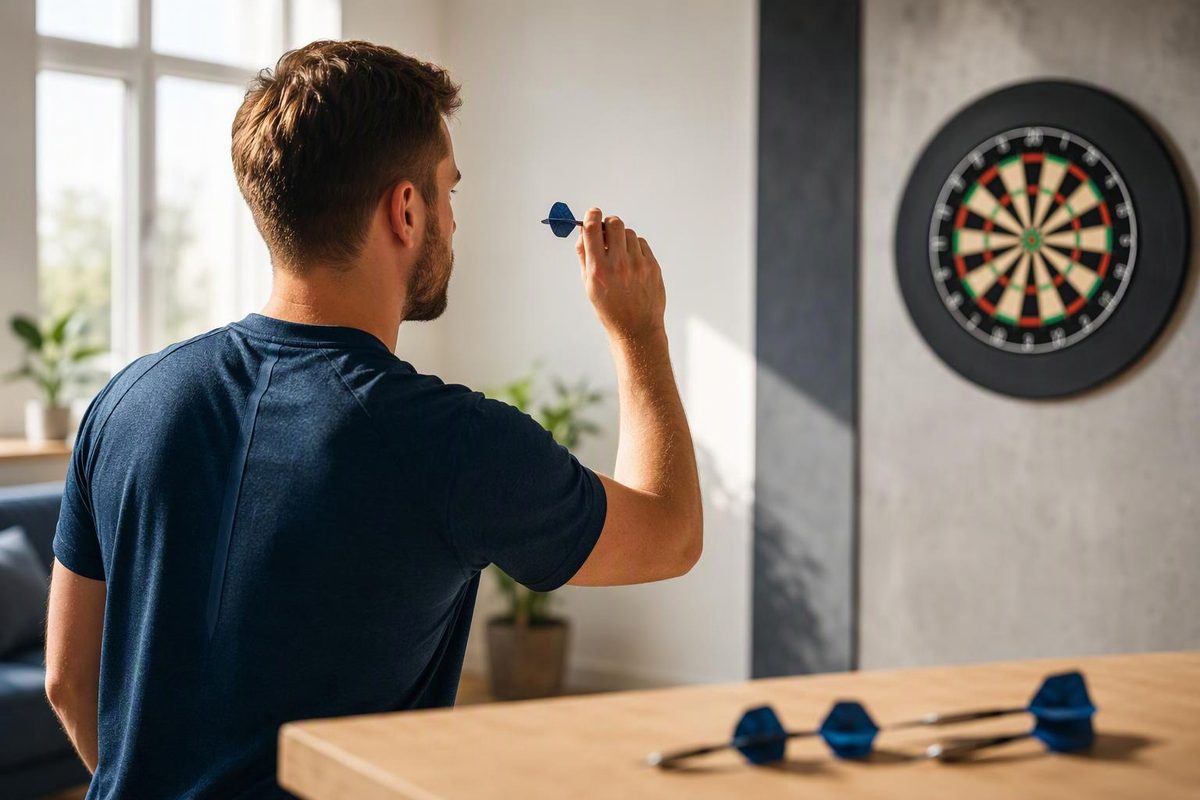
Useful goals and goal setting in darts start with one area of your game, a repeatable test, one action to practise and a review date. For doubles, establish a baseline with three 60-dart tests, choose a target from your own results, and compare the final three tests—not your best session—with that baseline.
Enter your hits from three completed 60-dart tests to calculate your doubles baseline.
Three-Test Doubles Baseline
Each test must include all 60 darts: 30 at D16 and 30 at D20. Enter total hits, not percentages.
24 / 180 hits
Hit rate: 13.3%
Compare this total with your final three completed tests. It does not prescribe your target.
Starting values are illustrative, not a benchmark. Use whole hit counts from 0 to 60; leave an unfinished test blank.
Source: the article’s 60-dart doubles protocol and illustrative scores of 7, 9 and 8 hits.
Separate the Result From the Action
Do not start with a simultaneous push for a higher average, better checkouts and a new throw. Choose one priority, then give each type of goal a distinct job:
| Goal Type | Darts Example | What It Measures |
|---|---|---|
| Outcome | Win more league singles matches this season | The result you want, which also depends on your opponents |
| Performance | Raise your hit count in a fixed doubles test | Your results under the same test conditions |
| Process | Set your front foot in the same chosen position before raising the first dart of each visit | The action you intend to repeat |
Keep the outcome goal as your direction. Build practice around the performance and process goals, which you can assess without needing to beat someone else.
The Association for Applied Sport Psychology’s goal-setting guidance recommends specific, observable goals, a deadline, written monitoring and a strategy for achieving them. It also recommends setting practice goals as well as competition goals.
Establish Your Baseline With Three Doubles Tests
Use this 60-dart doubles test to make sessions comparable:
- Use your usual board setup and darts. Complete the same brief, unscored warm-up each time.
- Throw one three-dart visit at double 16, then one at double 20.
- Repeat that pair ten times: 30 darts at each double, 60 in total.
- Keep aiming at the nominated double with all three darts, even after a hit. This is a target test, not a checkout game.
- Record hits on each double separately. Every dart thrown counts as an attempt; only a dart retained in the nominated double counts as a hit.
Complete the test on three separate days. Add the hits together to establish your starting result out of 180 darts. Your baseline hit rate is total hits divided by 180, multiplied by 100.
For example, scores of 7, 9 and 8 hits give 24/180, or 13.3%. That is an illustrative baseline, not a standard you should already meet. The calculator starts with those example scores; replace them with your own completed tests.
Recording practice scores is also recommended by darts training provider GoDartsPro. Use the record to compare sessions rather than relying on how well you remember throwing.
Set a Stretch Target and One Process Cue
Using the example baseline, a trial goal could be:
Over the next three weeks, complete three 60-dart doubles sessions each week. Aim for at least 30 hits across the final three sessions, compared with the baseline of 24/180.
Thirty hits from 180 darts is 16.7%. The six-hit increase is a planning example, not a promised gain or a research-backed progression rate. There is no prescribed improvement rate here: choose your target after seeing your own baseline and deciding how much practice you can realistically complete.
Set one process cue alongside it:
Before the first dart of every visit, place my front foot in the same chosen position, then raise the dart.
This is a consistency check, not a claim that everyone needs the same stance. After each visit, mark whether you completed the cue. You will have a process score out of 20 visits, separate from your doubles score.
If your priority is scoring or checkout construction instead, choose a repeatable test from these scored darts practice routines. Keep its rules unchanged throughout the goal period.
Record Hits and Cue Completion Separately
A notebook or simple spreadsheet is enough. Keep the two double scores visible as well as the total:
| Session | D16 Hits /30 | D20 Hits /30 | Total /60 |
|---|---|---|---|
| Example | 4 | 5 | 9 |
Alongside that example row, record cue completed: 18/20 visits, with the brief note: “Rushed stance after two poor visits.” The hit count measures accuracy; the cue count records whether you performed the chosen action.
Do not restart after a bad opening or stop after a personal best. Finish the planned test and record it. Avoid changing darts, targets and technique together: you would be comparing different tasks rather than repeating the same one.
For league play, carry over the process cue rather than demanding the practice hit rate. Choose a match goal such as “complete my stance setup before each visit,” then note afterwards whether you maintained it. For a broader match reset routine, use the emotion regulation checklist.
Review the Block, Not the Best Session
At the review date, compare the final three tests with the three baseline tests. Keep the individual results visible: one exceptional session is not the same as three consistently stronger ones. A higher total does not by itself prove that the cue caused the gain or that it will transfer to match finishing.
| Result at Review | Next Step |
|---|---|
| Target met across the block | Repeat it to check consistency, or make a small increase for the next block. |
| Hit count unchanged, cue more consistent | Record the process improvement, but do not call it improved doubles accuracy yet. |
| Practice sessions missed | Make the schedule more achievable before raising the target. |
| Neither measure improving | Simplify the cue or reconsider the practice task. Change one thing at a time. |
Your next goal should fit in one sentence: “By this date, I will complete this test this often, aim for this result and repeat this one action.”