
Choose Steel Tip Darts by Fit, Then Test the Results
Choose steel tip darts by weight, barrel shape and grip, then compare sets with a repeatable 60-dart scoring and doubles test.
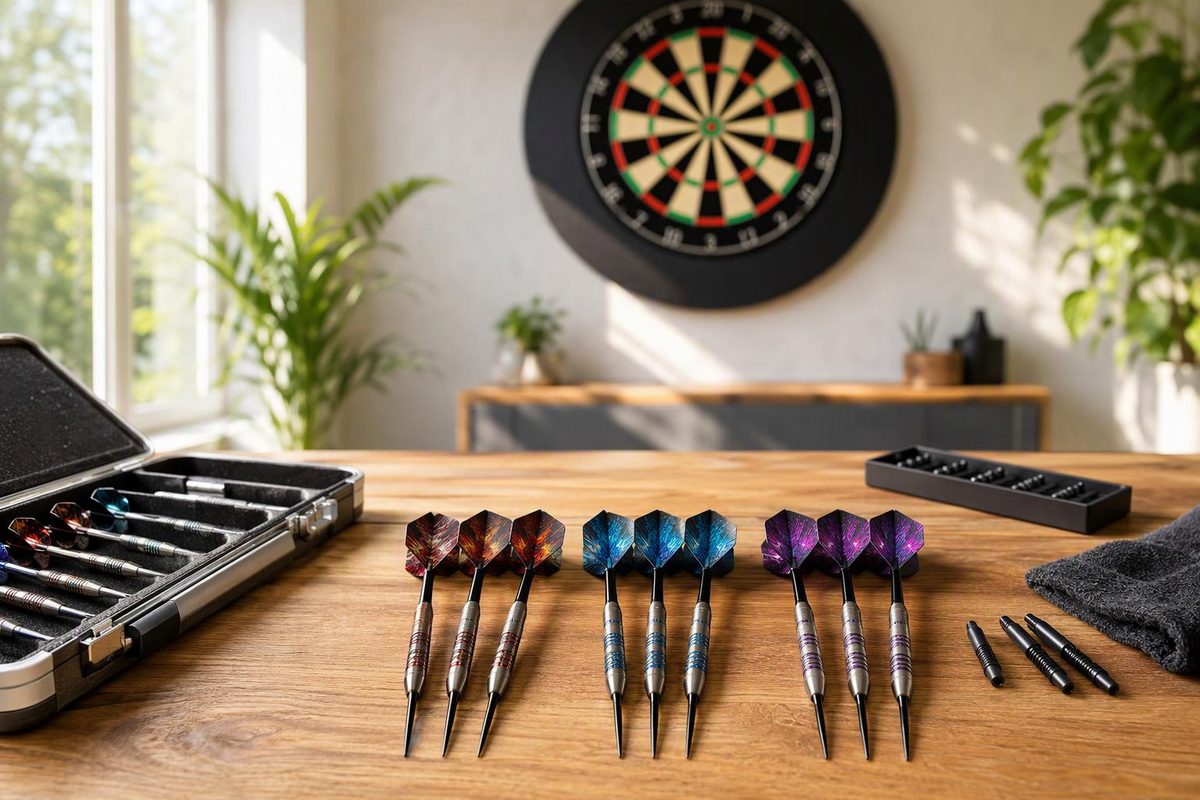
Steel tip darts have sharp metal points for use on bristle dartboards. If you are choosing your first set, start with a comfortable barrel and a manageable weight—not a professional player’s name or the highest tungsten percentage. Then keep the setup stable long enough to record how it performs.
Steel tip or soft tip: match the board first
Steel tip refers to the point, not the barrel material. The barrel—the part you usually hold—can be brass or a tungsten alloy, for example.
Soft tip darts have flexible plastic points intended for boards with moulded holes, commonly electronic scoring boards. Do not use steel points on a plastic soft-tip board unless its manufacturer explicitly permits them. Electronic scoring alone does not establish compatibility: some electronic boards have steel-tip-compatible surfaces. Shot’s explanation of steel and soft tips covers this distinction.
For a standard steel-tip practice setup, place the bullseye 1.73 m (5 ft 8 in) above the floor and the throwing boundary 2.37 m (7 ft 9¼ in) horizontally from the mounted board face, not the wall. The metric dimensions are specified in the DRA’s 2026 rules, effective from 31 March 2026; the imperial figures are customary equivalents. Use our dartboard setup guide for the measuring steps.
Choose weight, barrel and grip by fit
Weight: pick a starting point, not an ideal
If you have no preference, 23 g or 24 g is a reasonable first trial. This is a starting suggestion, not a prescription. Unicorn’s weight guidance places most players’ preferences between 21 g and 26 g and recommends trying different weights.
Borrow sets or use a shop’s trial board where possible. Ask yourself:
- Can I throw without deliberately forcing or slowing the action?
- Does the dart feel comfortable through a full practice block?
- Can I repeat the release without changing my grip each visit?
When comparing weights, use the same barrel model if available. Otherwise, remember that you are testing the whole set: a different shape or grip may explain the result as much as the weight.
Barrel: buy dimensions that fit your hand
Brass is generally the cheaper option. Tungsten’s greater density permits slimmer barrels than brass at comparable weights; Unicorn explains the material difference. That can leave more room around neighbouring darts, but it does not make your throw accurate by itself.
A straight barrel is a useful first shape to try because you can explore different holding positions. Darts Corner’s selection guide also recommends starting straight and borrowing other shapes to compare.
Check the actual barrel length and diameter, not just tungsten percentage. Your fingers should fit where you naturally hold the dart, without being crowded onto a taper or repeatedly searching for a comfortable position.
Grip: judge the release, not just the texture
Handle the dart, then throw it. A deeply cut barrel may feel secure in your hand yet uncomfortable during release. A smoother one may suit you better—or may feel too slippery. Grip choice depends on how you release, as Darts Corner notes.
Use one observable cue: place your thumb and fingers on the same barrel landmarks before each throw. Count occasions when you have to readjust. If you are unsure about placement, use the dart grip guide rather than squeezing harder by default.
Test a set with 60 recorded darts
Use this practical comparison drill after an equal warm-up with each set. Keep the board, stance, targets and pace unchanged. Where compatible, use matching flights and shaft lengths so they are not extra variables.
| Block | Action | Record |
|---|---|---|
| Scoring | Throw 30 darts at treble 20, in ten three-dart visits | Each visit’s actual board score and the total |
| Doubles | Throw 15 darts at double 16, then 15 at double 20, in three-dart visits | Hits on each intended double |
| Release check | Throughout both blocks | Grip readjustments and any recurring release discomfort |
In the doubles block, keep aiming at the same double for all 15 darts, even after a hit. This is a target test, not a checkout game.
For the scoring block, divide the total by 10 to get the scoring-only three-dart average, not a 501 match average. For doubles, divide intended-double hits by 30, then multiply by 100 for the combined hit percentage.
Count bounce-outs and darts that fall out before retrieval as zero; do not replace them with extra attempts. That matches the DRA’s normal-play rule that these darts do not count and cannot be rethrown.
If comparing two sets, repeat the test on three separate days and alternate which set goes first. Keep each day’s results rather than saving only the best run. Prefer the set that combines comfortable, repeatable handling with consistently useful scores and doubles results—not the one that produced a single spectacular visit. If the results are mixed, do not force a winner: keep your current set or choose the more comfortable option. This is a practical selection check, not proof that one set will raise your match average.
Before each session, check for damaged flights, shafts and points, and keep spare flights and shafts available, as Unicorn’s maintenance guidance recommends. Once you choose a set, leave it unchanged while you establish a practice baseline. You need comparable sessions before another equipment change can tell you anything useful.