
How Far Back Should You Stand From a Dartboard?
Set the oche 7 ft 9¼ in away for steel tip or 8 ft for soft tip, measured from the mounted board face to the line’s board-side edge.
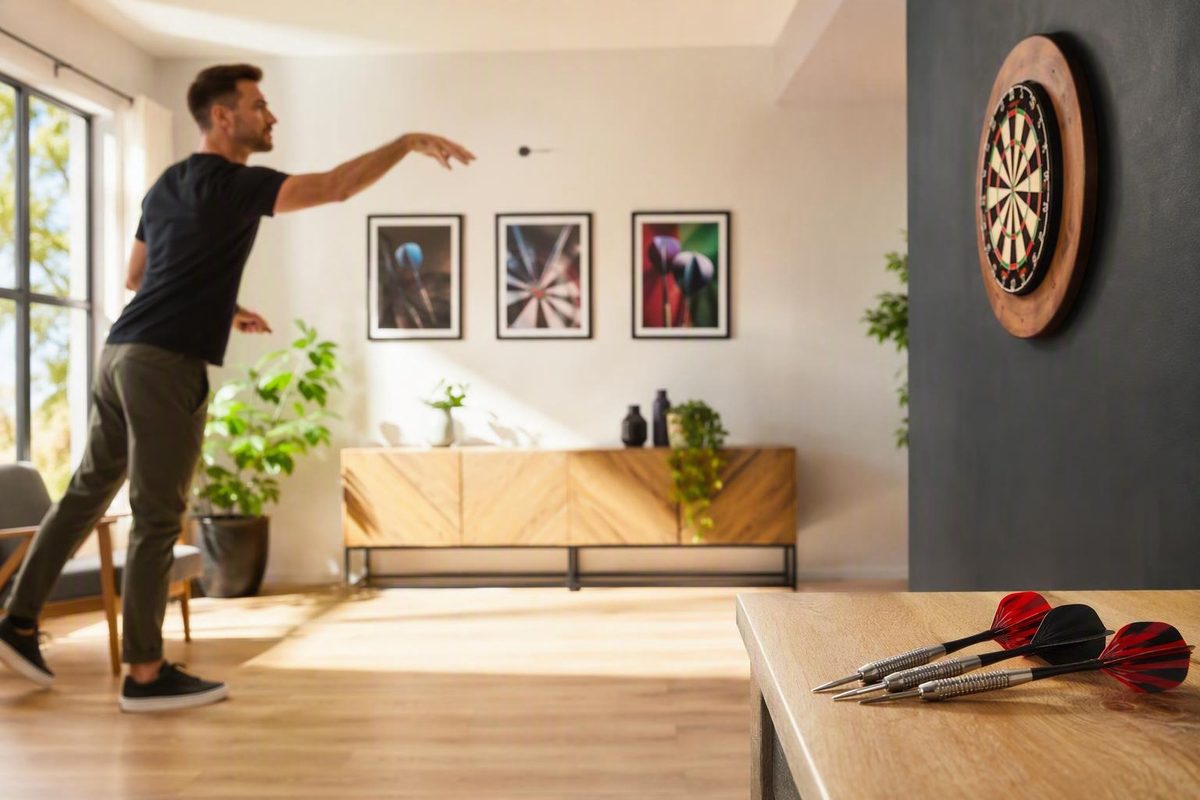
Darts distance at a glance: steel tip vs soft tip
For steel-tip darts, place the board-side edge of the oche 7 ft 9.25 in—equivalently 7 ft 9¼ in—from the front playing face of the mounted dartboard. The direct metric conversion is approximately 2.369 m, commonly rounded to 2.37 m. For soft-tip or electronic darts, the commonly published distance is 8 ft, or 2.44 m, from the board face. In both formats, the commonly published bullseye-center height is 5 ft 8 in, or 1.73 m, above the finished floor. These measurements are summarized in the Darts Corner setup guide.
| Format | Horizontal distance from board face to board-side edge of oche | Bullseye-center height |
|---|---|---|
| Steel tip | 7 ft 9.25 in / 7 ft 9¼ in / about 2.37 m | 5 ft 8 in / 1.73 m |
| Soft tip or electronic | 8 ft / 2.44 m | 5 ft 8 in / 1.73 m |
The oche is the throw line. For installation, the important reference point is its edge nearest the dartboard: that is where the horizontal measurement ends and where players must keep their feet behind.
These are commonly published setup measurements, not proof that every league, tournament, accessible format, or electronic machine follows identical rules. The available evidence consists primarily of retailer and third-party setup guides rather than current primary rulebooks. For competitive play, confirm the dimensions and oche requirements with the relevant league, event, governing organization, or electronic-machine specification.
The basic installation sequence is:
- Identify whether the setup is for steel-tip or soft-tip darts.
- Mount the board with the bullseye center at the correct height.
- Measure from the mounted board’s front face—not the wall.
- Place the board-side edge of the oche at the format-specific distance.
- Verify the height and distance before fixing the line permanently.
Measure from the board face—not the wall
The horizontal darts distance begins at the front playing face of the mounted board. It does not begin at the wall, mounting bracket, back of a cabinet, or floor point directly below the wall. At the other end, it finishes at the edge of the oche nearest the board. The Dartshopper distance guide likewise describes the steel-tip distance as running from the front of the dartboard to the throw line.
If the oche is tape, use its board-side edge. If it is raised, use the face or edge nearest the dartboard. That edge is the no-step boundary for the setup.
SIDE VIEW — NOT TO SCALE

             Wall
              │
              │   Mounting hardware /
              │   cabinet / backing panel
              │      ┌───────────┐
              │      │ Dartboard │
              │      │     ●─────┼── Bullseye center
              │      └───────────┘   5 ft 8 in / 1.73 m
              │             ↑
              │        Board face
              │             │
Finished      └─────────────┼───────────────────────────────┬────
floor                       │<── horizontal distance ──────>│
                            │                               │
                    Vertical projection                Board-side
                    of board face                      edge of oche
                                                       ███████
                                                       Oche /
                                                       throw line
The board face projects into the room. A cabinet, backing panel, surround, mounting bracket, stand, or clamp can increase that projection. If you measure the specified distance from the wall, the resulting oche will normally be too close to the playing face by the amount that the face projects from the wall.
For example, suppose a steel-tip line was marked by measuring from the wall. You then install a thicker bracket that moves the playing face farther into the room. The wall and floor mark remain fixed, but the actual board-face-to-oche distance becomes shorter. The correct response is to start from the new board-face position and move the oche farther into the room—not preserve the wall-based mark.
Mount the board completely before locating the throw line. Install the cabinet, backing, bracket, stand, or clamp; put the board in its final playing position; and only then measure to the oche. If any mounting component changes later, measure again.
A skirting board can make the mistake less obvious. Dropping a tape from the wall may establish a starting point beneath the skirting rather than beneath the board face, while a cabinet may project much farther forward. The reliable approach is to transfer the plane of the playing face vertically to the finished floor and begin the horizontal measurement there.
How to set up the board and oche step by step
You do not need specialist equipment, but a few basic tools make the installation easier.
Tools:
- Tape measure
- Pencil or removable marker
- Level
- Tape, dart mat, or raised oche
- Optional plumb line or weighted string
- Mounting hardware suitable for the board and supporting surface
A plumb line is a practical way to transfer the board-face plane to the floor. It is an installation aid, not a separate rule.
1. Choose an unobstructed location
Choose a position with room for the mounted board, full throwing distance, player stance, and normal movement around the oche. Keep the throwing lane away from doors, walkways, fragile objects, and places where another person could unexpectedly cross it. Darts Corner similarly recommends a safe area with sufficient space and no obstructions.
Account for the board type. Steel points require particular care around people and surrounding surfaces. An electronic board may require access to power and enough space for its casing. Follow the manufacturer’s mounting and operating instructions.
Do not treat a retailer’s suggested room-clearance dimensions as universal competition rules. The practical aim is an unobstructed lane in which the intended height and throwing distance can be maintained safely.
2. Securely mount the board before measuring the oche
Install the cabinet, backing panel, mounting plate, bracket, clamp, stand, or other hardware first. Then mount the board in its actual playing position. Third-party installation guidance recommends securing the board so it does not move during play.
The board should not shift when darts are removed or when a cabinet is opened and closed. If the mount allows board rotation, check that rotation does not alter the plane of the playing face.
Do not mark the final oche yet. Its position depends on where the installed playing face ends up.
3. Set the bullseye center at 5 ft 8 in
Measure vertically from the finished floor to the exact center of the bullseye. The commonly published height for steel-tip and soft-tip boards is 5 ft 8 in, or 1.73 m, according to the GLD Products installation guide.
“Finished floor” means the surface on which the player stands. If a fixed floor covering or permanent dart mat changes that level, measure from the standing surface actually used. Do not measure to the top or bottom of the board, the cabinet center, or the mounting screw.
Check the mounting arrangement with a level as appropriate. Confirm the bullseye height after tightening the hardware because the board may settle slightly during installation.
4. Transfer the board-face plane to the floor
Hold a plumb line against, or immediately in front of, the playing face without damaging it. Let the weight settle, then mark the point on the floor directly beneath that plane.
If a plumb line is unavailable, use another careful vertical-reference method. The purpose is to identify the point directly below the mounted board’s front face—not to measure diagonally from the wall.
That floor mark is the starting point for the horizontal measurement.
5. Measure horizontally along the finished floor
From the board-face projection, measure straight outward along the playing lane:
- Steel tip: 7 ft 9.25 in or 7 ft 9¼ in, approximately 2.369 m and commonly rounded to 2.37 m
- Soft tip: 8 ft, or 2.44 m
The GLD setup guide publishes these format-specific horizontal distances from the board face.
Keep the tape straight along the lane and level with the floor. Do not let it curve around furniture or run diagonally. Use one unit system throughout the installation; repeated conversions can introduce avoidable rounding differences.
6. Put the board-side edge of the oche at the measured point
The measured point identifies the edge of the throw line nearest the board.
For tape, align the board-side edge with the mark. Do not center a wide strip over the point unless you deliberately account for half its width. A narrow line with a clearly defined front edge is easier to reproduce and judge.
A printed dart mat can make the distance easy to see, provided the correct marking is aligned with the board-face projection. Check whether the mat shows steel-tip, soft-tip, or both distances.
A raised oche provides a physical stop for the front foot. Its dimensions and construction may vary between venues and competitions, so do not assume one width or height is universal.
7. Remeasure after everything is fixed
Once the board and oche are secured, verify:
- The floor-to-bullseye-center height
- The board-face-to-oche distance
- The oche’s alignment across the lane
- The stability of the board and line
Repeat these checks after changing a cabinet, bracket, backing panel, clamp, stand, mat, or floor surface. A small change behind the board can alter the playing-face position even though the wall has not moved.
For casual setups, removable tape or a dart mat may be sufficient. In a shared room, a removable oche can preserve floor space. Whatever marker you use, the location of its board-side edge determines the throwing distance.
Use a diagonal measurement as a cross-check
A diagonal measurement from the bullseye to the oche can help verify a completed setup. Treat it as an approximate cross-check, not a replacement for independently setting the bullseye height and horizontal board-face distance.
Published setup guides give these approximate diagonals:
| Format | Approximate bullseye-to-oche diagonal |
|---|---|
| Steel tip | 2.93 m |
| Soft tip or electronic | 2.98 m / 9 ft 9.5 in |
The GLD Products guide reports approximately 2.93 m for steel tip and 2.98 m / 9 ft 9.5 in for soft tip. The soft-tip pair should be understood as source-reported approximations rather than an exact mathematical equivalence derived from the article’s rounded horizontal and vertical figures.
Published steel-tip imperial values also differ slightly. GLD reports 9 ft 7⅜ in, while the Net World Sports buyer’s guide reports 9 ft 7½ in; both accompany an approximate metric figure of 2.93 m. Because the guides conflict at the final fraction, neither imperial value should be treated here as universally exact.
To check the setup, place one end of the tape at the bullseye center and extend it diagonally to the board-side edge of the oche. Keep the tape taut; a second person can make this easier.
If the horizontal distance appears correct but the diagonal is substantially different from the published approximation, investigate before moving the oche. Possible causes include:
- The bullseye is too high or too low.
- The horizontal measurement began at the wall.
- The wrong edge of the oche was used.
- The tape did not reach the exact bullseye center.
- The floor reference was not the actual standing surface.
- Steel-tip and soft-tip measurements were mixed.
The diagonal combines height and horizontal distance in one reading. It can reveal that something is wrong, but it cannot identify which component is wrong. Establish the bullseye height and horizontal distance separately, then use the diagonal only as confirmation.
Oche rules: feet, leaning, and line placement
The oche is the throw line, and the relevant boundary is the edge nearest the dartboard. Players’ feet must remain behind that boundary while throwing. The upper body may lean forward over the line, provided the feet do not cross it, as described in the Net World Sports setup and foot-position guide.
The oche controls foot position, not the position of the player’s head, shoulder, throwing hand, or dart in flight. A substantial forward lean does not move the legal foot boundary.
For a taped oche, make the board-side edge visually unambiguous. A contrasting color or a small adjacent label such as “stand behind this edge” can help. That is practical setup guidance, not a universal marking rule.
Do not use the middle or rear edge of a wide tape strip as the boundary. If one player measures from the front edge while another stands behind the back edge, they are using different effective throwing distances.
A raised oche can be easier to judge because the player can place a foot against it without repeatedly looking down. A dart mat with a distinct printed line offers similar visual clarity without adding a raised obstruction.
One oche width, height, material, or construction does not necessarily apply to every event. A home setup may use tape, a pub may use a mat, and a competition may specify a raised structure. Check the relevant rules before constructing a permanent competition lane.
Fix common setup errors
If a measured setup still feels wrong, inspect the reference points. Most errors result from using the correct number between the wrong two places.
Measuring from the wall
Symptom: The player stands closer to the playing face than the intended distance, even though the floor mark was measured correctly from the wall.
Cause: The board face projects into the room, but the tape began at the wall.
Fix: Project the mounted board face vertically to the floor and remeasure from that point. Move the oche farther from the board as needed.
Marking the line before mounting the board
Symptom: A floor mark no longer gives the intended distance after installation.
Cause: The cabinet, backing panel, bracket, clamp, stand, or board depth moved the face forward.
Fix: Complete the mounting first, establish the final board-face projection, and reposition the oche.
Measuring to the wrong edge of the oche
Symptom: Different people obtain different measurements from the same line.
Cause: One person measures to the middle or player-side edge of the tape or raised oche.
Fix: Use the board-side edge consistently and make it easy to identify.
Measuring board height to its outer edge
Symptom: The board looks high or low even though a vertical dimension was measured.
Cause: The measurement was taken to the top, bottom, bracket, or cabinet center rather than the bullseye center.
Fix: Measure vertically from the finished standing surface to the exact center of the bull.
Mixing steel-tip and soft-tip distances
Symptom: A soft-tip setup is several inches closer than intended, or a steel-tip setup is farther away than intended.
Cause: The wrong format-specific distance was used.
Fix: Confirm the board type. Commonly published measurements are 7 ft 9.25 in / about 2.37 m for steel tip and 8 ft / 2.44 m for soft tip, measured from the board face.
Changing the mount without rechecking the oche
A different bracket, cabinet, backing board, stand, surround, or clamp can move the playing face. Darts Corner specifically notes that a clamp can move the board outward and that the board-face-to-oche distance should then be checked again. A floor line is not necessarily still correct merely because the wall mounting point is unchanged.
Dealing with a sloped or uneven floor
An uneven surface complicates both the vertical and horizontal measurements. Do not invent a correction based on whichever point is easiest to reach. For a competition installation, consult the relevant organization or event rules; for a permanent venue, seek suitable installation guidance. A diagonal check may reveal inconsistency, but it is not an automatic authority for resolving every floor condition.
Final three-point audit
Before throwing, verify:
- Bull center: 5 ft 8 in / 1.73 m above the finished floor.
- Horizontal distance: 7 ft 9.25 in / about 2.37 m for steel tip or 8 ft / 2.44 m for soft tip, measured from the mounted board face.
- Oche boundary: the board-side edge is clearly marked and used consistently.
These dimensions are supported by the Darts Corner setup guide; competition and machine-specific rules should still be checked.
Limited space, casual play, and league variations
Standard setup dimensions are different from optional home arrangements. You can install a board in a shorter space, but the result is not the same setup as the commonly published full distance.
If the room is too short, first consider ways to preserve the intended distance:
- Throw along the room’s longer diagonal.
- Use a suitable corner layout.
- Install a removable board or stand that can be positioned for play.
- Use a temporary oche across the room.
- Reorient nearby furniture.
- Move the setup to a larger room, garage, outbuilding, or other suitable location.
These are practical options, not formal layout rules. The lane should remain unobstructed, and other people should be kept away from the line of throw.
Participants in a Darts Nutz forum discussion suggest using a corner, the room’s diagonal, or another location instead of permanently shortening the distance. Their claims that shorter practice changes technique, power, or dart-entry angle are anecdotal opinions—not controlled evidence. The discussion does not establish that closer practice damages technique or that longer-distance practice improves it.
For casual play, you may choose a nonstandard arrangement, but label it clearly. A separate family or accessibility line avoids confusing a shortened option with the full-distance oche. If you later want to reproduce league or tournament conditions, add another clearly identified line at the required distance.
The available evidence does not establish one universal distance exception for women, junior players, wheelchair players, or other accessible formats. The Net World Sports buyer’s guide says the standard distance remains the same for women and juniors while also reporting that some leagues may permit shorter alternatives. That supports only the possibility of league-specific variation—not a general rule.
Accordingly:
- Women players: Do not assume a different distance based on gender.
- Junior players: Check the rules of the relevant school, league, or event.
- Wheelchair and accessible formats: Obtain the current requirements of the applicable organization.
- Soft-tip players: Check the machine or operator specification as well as league rules.
- Tournament entrants: Follow the event documentation even if a home line uses a commonly published measurement.
Keep room-clearance recommendations separate from board height and oche distance. A retailer’s preferred lane width or free space behind the player may be useful planning guidance, but it is not automatically a competition rule.
For a dependable setup, identify the format, mount the bullseye center at 5 ft 8 in / 1.73 m, measure from the mounted board’s front face, and place the board-side edge of the oche at 7 ft 9.25 in / about 2.37 m for steel tip or 8 ft / 2.44 m for soft tip. These commonly published figures are summarized by Darts Corner.
Because the cited evidence is third-party guidance rather than the relevant primary rulebook for every form of play, competitive players should confirm organization-, league-, event-, accessibility-, and machine-specific requirements before using the lane.
Is dartboard distance measured from the wall or the front of the board?
Measure from the front playing face of the mounted dartboard, not the wall, to the edge of the oche nearest the board. The Dartshopper setup guide gives the steel-tip distance as 7 ft 9¼ in / 2.37 m between those reference points.
Measuring from the wall normally places the oche too close to the playing face because the board and mounting hardware project into the room. Mount the board first, transfer its face vertically to the floor, and then measure outward.
How high should the center of the bullseye be?
The commonly published height is 5 ft 8 in / 1.73 m, measured vertically from the finished standing surface to the exact center of the bullseye. The GLD Products guide publishes that height for both steel-tip and soft-tip boards.
Do not measure to the top or bottom of the dartboard, the cabinet center, or the mounting screw.
Is the throwing distance different for soft-tip darts?
Yes. Commonly published distances are 8 ft / 2.44 m for soft-tip or electronic darts and 7 ft 9.25 in / about 2.37 m for steel tip, as also distinguished in Dartshopper’s soft-tip versus steel-tip overview.
Measure either distance from the mounted board’s playing face to the board-side edge of the oche. Check the electronic machine or competition specification before formal play.
Can my foot cross the oche if I lean forward?
No. Players must keep their feet behind the board-side edge of the oche, although the upper body may lean forward over the line. This foot-position distinction is described in the Net World Sports buyer’s guide.
Make the front edge of a taped line clear, or use a correctly positioned mat or raised oche so players can judge the boundary consistently.
Do women and junior players use a different darts distance?
Not universally. Net World Sports reports the standard distance as the same for women and junior players while noting that some leagues may allow shorter alternatives. Because that is retailer guidance rather than a universal governing-body rule, verify the applicable league or event requirements.
Do not change the distance solely because of a player’s age or gender. Follow the rules of the relevant league, school, youth organization, tournament, or governing body.