
Audit the Throw You Want to Repeat Under Pressure
Audit one observable throw cue across blocked, switching and next-day darts, then decide whether to keep, simplify or replace the action you take to the oche.
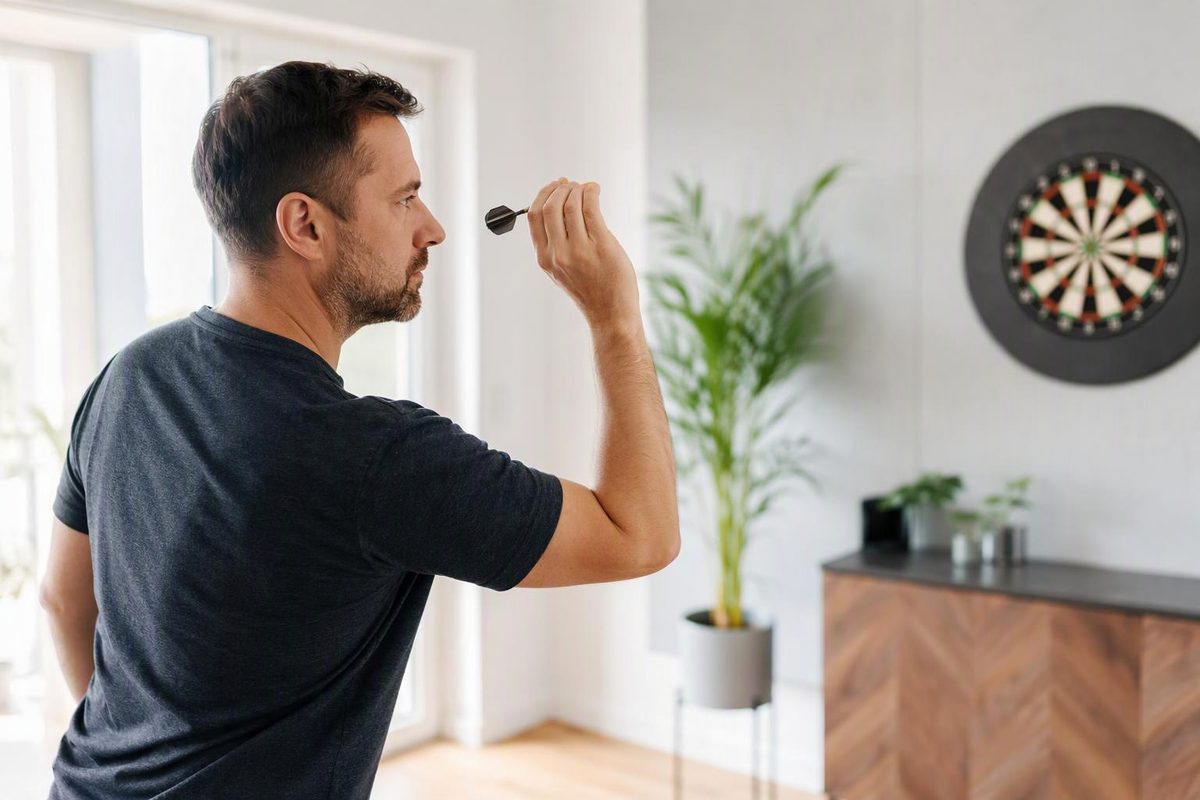
“Practice makes permanent” is a warning, not a promise. Repetition makes a familiar throw easier to reproduce, but it does not automatically make that throw accurate—and an established action is not literally permanent. Repeat the action you want available in a match, then check that you are actually repeating it.
Choose what happened across three audits; the tool will tell you whether to keep, test or replace the cue.
Cue Decision After Three Audits
Use the pattern across all three practice days, not one unusually good or bad block.
Decision rule: keep a cue only when it becomes more repeatable without clear worsening or discomfort; mixed evidence needs another clean audit.
Source: the three-day, 30-dart audit protocol and cited motor-practice reviews discussed in this article.
A treble can reward an off-balance throw, while a well-executed dart can land just outside the target. That is why this audit records both the result and one observable feature of your throw.
Repeat the action you want available in a match, and check that you are actually repeating it.
Do Not Practise a Feeling You Cannot Check
“Throw smoothly” and “be more consistent” are intentions, not useful measurements. Choose one cue that you can see, count or verify on video.
A practical starting cue is:
Hold the finish until the dart reaches the board.
This does not prescribe a universal follow-through. It gives you a checkpoint: did you complete the throw without snatching the hand back, stepping away or losing your balance?
Other workable cues include:
- Place the front foot on the same oche mark before every visit.
- Begin each dart with the point in the same visible position.
- Use one breath before raising the first dart of every visit.
- Keep your gaze on the chosen target through the release.
Pick one, not all four. Multiple technical instructions make it difficult to identify which change affected the throw. If grip is the variable you want to test, use a controlled comparison rather than changing it between visits; this grip-testing method provides a separate protocol.
Run the 20-Minute Practice Audit
The main session consists of three 30-dart blocks. Add a fourth block at the start of practice the next day.
Use your normal darts and a correctly positioned board and oche. Put your phone safely to the side of the throwing area if you plan to record video. Nobody should be near the board while darts are being thrown.
Draw a table with these columns:
| Block | Darts | Results | Cue Completed |
|---|---|---|---|
| Baseline | 30 | Hits and score | /30 |
| Cue block | 30 | Hits and score | /30 |
| Switching block | 30 | Hits only | /30 |
| Next-day test | 30 | Hits and score | /30 |
1. Establish a 30-Dart Baseline
Throw ten visits at the 20 segment. Score the board normally and count how many darts score anywhere in the 20 wedge, including either single area, treble 20 or double 20. Do not deliberately change your mechanics yet.
After each visit, mark how many of its three darts met your chosen cue. If you cannot judge the cue reliably, record three visits from the side and review them after the block—not after every dart.
This separates two kinds of information. Motor-learning research calls information about the outcome knowledge of results and information about movement quality knowledge of performance. A systematic review of augmented feedback uses the same distinction. In this drill, segment hits and score are results; cue completion is performance information.
2. Repeat the Cue for 30 Darts
Throw another ten visits at 20. Before each visit, state the cue once: “hold the finish,” for example. Then throw normally.
Do not rebuild your action after every miss. Complete the three-dart visit, record it, step back and reset. A dart landing in the 5 does not prove that your elbow, grip or release needs an immediate change. Look for a pattern across the block.
Your objective is not 30 perfect throws. It is an honest count. If you held the finish on 21 of 30 darts, write 21/30, even if the score was excellent.
3. Test the Cue While Switching Targets
Throw ten visits using this sequence:
- Visit 1: 20, 19, 18
- Visit 2: 17, 16, 15
- Repeat that pair of visits five times
Count segment hits and cue completion, but not total score. Changing the target prevents you from simply repeating one sight line. The block tests whether the same pre-throw setup and finish survive while your aim changes.
Variable practice can feel less successful during the session. That is not necessarily a bad sign. A 2020 laboratory study found that participants who had fewer consecutive repeats improved more over four days than a group given frequent repeats. However, they performed a computer-based finger-response task, not darts.
A broader systematic review and meta-analysis found an overall retention benefit for random over blocked motor practice, but the pooled effect in applied settings was small and statistically uncertain. Treat target switching as a test of whether your cue travels with your aim, not as a guaranteed shortcut to improvement.
4. Retest the Next Day
Before your next full practice session, repeat the original 30 darts at 20. Use the same cue, board and scoring method.
The next-day result matters more than a hot final block. Compare:
- Total score
- Number of darts in the 20 segment
- Cue completion out of 30
One retest can still be noisy, so run the audit on three separate practice days. Keep the cue if execution becomes more repeatable without a clear pattern of worse scoring, discomfort or tension.
Replace or simplify it if you cannot observe it, it causes pain, or both execution and results deteriorate across the three tests. A mixed result is not evidence that the cue has failed; it means you do not yet have a dependable pattern.
Make a Routine Permanent, Not a Pose
The target is not a frozen, cosmetically perfect throw. It is a small routine you can recognise and reproduce:
- Return to the same starting position.
- Direct attention to one target.
- Execute without adding a mid-throw correction.
- Finish in a position you can briefly hold.
- Record the result without judging the whole session by one dart.
Holding the finish is useful because it is observable, not because every player must finish in an identical position. The cue should support a balanced, repeatable action rather than force your arm into a shape that causes tension.
Once the cue survives target switching, put it under scoring and finishing pressure with a structured drill such as Bob’s 27, 121 or scored 501 against par. Keep measuring the cue for a few visits. If the action disappears as soon as the game matters, it was familiar in blocked practice but not yet dependable.
Practice makes repeated choices more familiar. The useful choice is one you can observe, measure and still reproduce when the target or pressure changes.