
Your Throw Hasn’t Vanished: Diagnose the Gap Between Home and the Oche
League play changes pace, scoring, finishing and attention. Compare like-for-like 501 sessions, then test one match variable before rebuilding your throw.
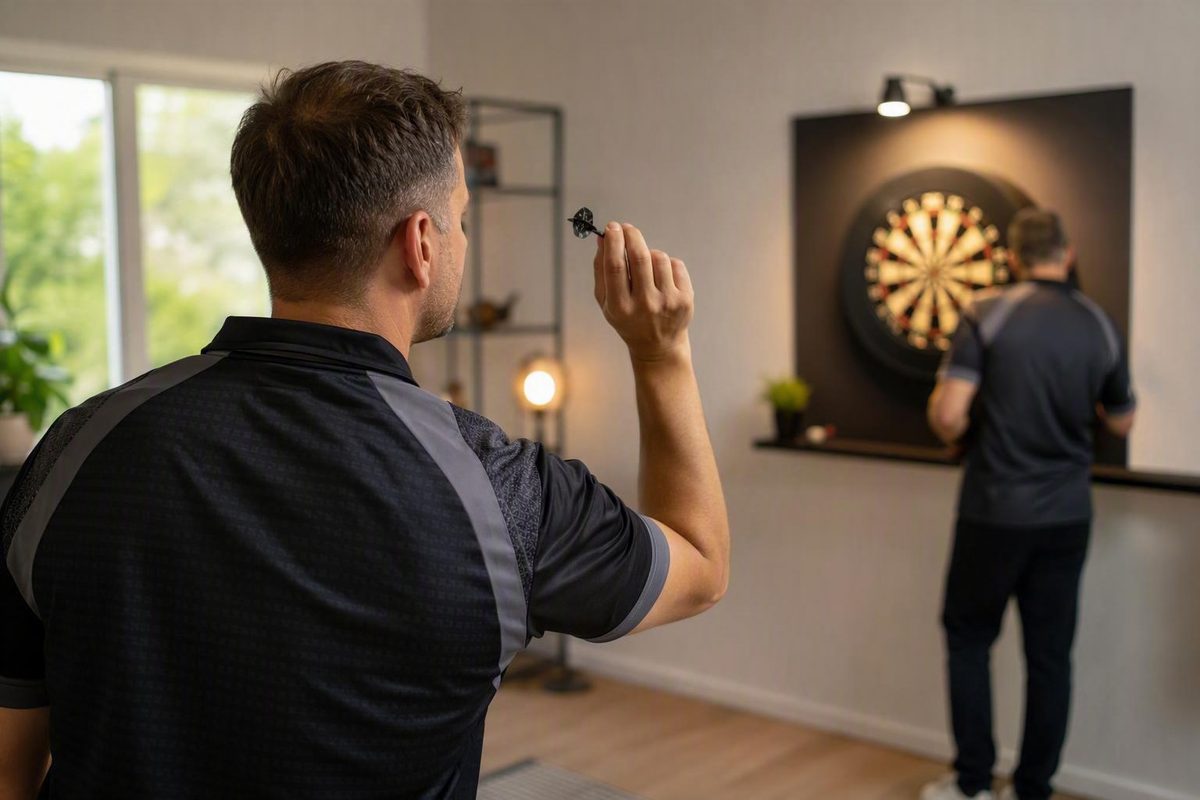
Your darts practice form may disappear in league matches because league play changes the task—not necessarily because your underlying throw has failed. Pressure is one possible contributor, but so are formal scorekeeping, longer pauses, finishing demands, unfamiliar surroundings, expectations, and attempts to control a normally automatic action. Before rebuilding your mechanics, compare like with like, identify where the decline begins, and test one match-related variable at a time.
The short answer: league play changes the task
Treat it first as a transfer problem between two environments.
At home, you may control the pace, begin each new visit with little delay, choose your warm-up, play without an opponent, and stop when concentration fades. A league match can add waiting, formal scorekeeping, teammates, consequences, unfamiliar lighting or noise, a different board and oche, restricted warm-up, and the requirement to finish every leg.
The apparent loss of form could therefore come from several places:
- Attention moves from the target and routine to the score or result.
- You consciously control your stance, grip, elbow, release, or follow-through.
- Waiting for an opponent disrupts the rhythm developed in solo practice.
- An unfamiliar venue changes your visual picture or preparation.
- Expectations make an ordinary poor visit feel unusually significant.
- Your home and league averages are calculated under different conditions.
One player, for example, reported home averages ranging from 57 to 76 but an average of 51.4 across five local games. That is a genuine reported difference, but it is one self-reported case and cannot establish why the decline occurred—or what happens to players generally. The figures come from an r/Darts discussion of practice versus local matches.
A match decline does not necessarily mean your throw has vanished or needs an immediate rebuild. It may mean that a throw developed in one setting is not yet sufficiently stable when pace, measurement, surroundings, and consequences change. That calls for diagnosis before reconstruction.
First confirm that the performance gap is real
A best practice night, a short run of strong legs, and a season average are not equivalent measurements.
Before interpreting your numbers, compare these conditions:
- Game format: Were both sets of results produced in 501?
- Finishing rules: Did every home leg require double-out?
- Missed doubles: Were they included in the home average?
- Warm-up: Did you have the same preparation time?
- Number of legs: Are you comparing a few good legs with an entire league period?
- Scorekeeping: Was practice formally recorded or reconstructed from memory?
- Session length: Did one result come before fatigue or loss of concentration?
- Opponent presence: Were you alone, playing online, or sharing an oche with an opponent?
- Pace: Did you throw continuously at home but wait between league visits?
- Selection: Were all practice sessions counted, including poor ones?
Consider the reported home range of 57–76 against a 51.4 average across five local games. Those figures demonstrate a reported gap, but they do not reveal whether the player used the same format, included every missed double, completed every leg, warmed up for the same period, or averaged results over comparable conditions.
A better test is to record multiple home sessions of complete 501 double-out under league rules. Use the same warm-up, count every dart, finish every leg, and retain ordinary and poor sessions rather than selecting only nights when the throw felt good.
Track at least two measures separately:
- Overall three-dart average, including finishing darts.
- Checkout percentage, using the same definition every time.
Use a diagnostic table instead of calling everything choking
The following tests can help narrow the possibilities. They are not validated diagnoses, and one pattern may have several explanations.
| Pattern | Plausible contributor | Test | Next experiment |
|---|---|---|---|
| Performance falls when scores are formally recorded | Attention to consequences or altered pace | Compare unscored practice with identically structured scored practice | Record every leg while keeping format, warm-up, and pace unchanged |
| Performance falls after waiting between visits | Rhythm disruption or dwelling on the previous score | Compare continuous solo play with practice containing opponent-like pauses | Insert a consistent pause and restart your normal routine before each visit |
| Scoring remains stable but doubles decline | Finishing-specific difficulty | Compare scoring measures with checkout percentage | Add complete double-out legs and a measurable doubles routine |
| Performance drops mainly after one poor visit | Attention remains on the mistake | Mark the visit after every clearly poor score | Use a brief reset and check whether the next visit returns to routine |
| Performance changes only at unfamiliar venues | Preparation or environmental difference | Record warm-up, lighting, noise, pace, and board or oche concerns | Recreate one observable condition at a time where possible |
| The throw also deteriorates during relaxed practice | Technique, setup, vision, discomfort, or fatigue may need attention | Compare relaxed sessions across different days and conditions | Review setup and mechanics in controlled practice rather than assuming match nerves |
The value of this table is separation. If formal scoring alone coincides with the decline, an opponent may not be necessary to trigger it. If doubles collapse while scoring remains normal, calling the entire throw broken hides the part that needs work. If the problem also appears in relaxed practice, match pressure becomes a less convincing explanation.
Venue notes should remain observations, not instant conclusions. Writing “short warm-up, bright light behind board, slower opponent” is useful. Declaring that one of those factors caused the result after a single match is not.
How pressure can disrupt attention and an automatic throw
Two theories help explain why trying harder can sometimes produce a worse action.
Distraction theory proposes that pressure redirects limited attention away from the immediate task. At the oche, attention that would normally remain on the target and routine may move toward the score, teammates, the previous visit, possible consequences, or the result of the leg.
Explicit monitoring proposes a different disruption: the player starts consciously controlling an action that normally operates more automatically. Instead of seeing the target and throwing, the player checks foot position, grip pressure, elbow movement, release timing, and follow-through during execution.
That makes “finding the practice throw” a potential trap. The more urgently you try to reconstruct every mechanical detail during a match, the less the action may resemble the familiar routine you are trying to recover. This is a plausible mechanism, not a diagnosis of what is happening to any particular player.
A possible cascade looks like this:
- One poor visit attracts extra attention.
- The player tries to prevent another mistake.
- Attention moves inward to mechanics or outward to consequences.
- The next visit feels forced.
- That result is treated as further evidence that the throw has disappeared.
Pressure should not, however, be treated as a universal explanation. A 2020 PLOS One study examined 32,274 throws from professional tournament darts and found no overall evidence of either choking or clutch performance in that dataset. The paper also discusses distraction and explicit monitoring as theories of pressure-related decline. Its group-level finding concerns highly skilled professionals, so it neither proves that individual amateurs never struggle under pressure nor directly compares home practice with amateur league play (professional darts performance-under-pressure study).
The practical conclusion is modest: pressure may affect attention or control, but you should test that explanation rather than assume it.
Protect match rhythm with a simple between-visits reset
Solo practice often allows the next visit to begin as soon as you have retrieved your darts. In a league leg, the opponent’s visit interrupts that rhythm and creates time to replay your previous score mentally. You cannot eliminate the wait, but you can give it a simple structure.
After a poor visit:
- Acknowledge that the visit is complete. Do not analyse it at the back of the oche.
- Take one slower breath.
- Let the opponent’s turn happen. Avoid rehearsing corrections for all three previous darts.
- Choose one external cue. Use the intended landing point or another simple target-based cue.
- Restart your normal pre-throw routine.
Use one cue in competition, not a checklist covering stance, grip, elbow, release, and follow-through. Detailed technical analysis belongs in controlled practice, where a change can be repeated and assessed without the immediate consequences of a league leg.
This reset is a low-risk experiment based on possible attention and rhythm problems, not a scientifically validated cure. Its purpose is not to erase the previous darts. The useful question is whether your next visit returns to the established routine, regardless of whether it produces a maximum or another ordinary score.
Recovery is a more realistic competitive skill than perfection. Poor visits will happen.
A home session that more closely resembles league play
Match-like practice should reproduce important constraints without pretending that solo play feels identical to a league night. Use this session as a practical starting point:
- Complete the same fixed warm-up each time. Keep its duration and structure consistent.
- Play fully scored 501 double-out. Do not stop when the scoring phase ends.
- Pause between visits. Step away and allow an opponent-like interval instead of throwing continuously.
- Finish every leg. Count every missed double.
- Record the result immediately.
For each leg, log:
- Overall three-dart average
- Missed doubles
- Checkout result
- Whether you completed the leg within a personal par
Choose a par that is useful for comparing your own sessions, not one that flatters or punishes you. Its purpose is to provide a stable reference point.
League legs require a transition from scoring to finishing, so practice should include that transition rather than separating every session into treble throwing or doubles alone. Winmau presents its Mental Checkout practice game as moving from scoring to finishing and intending to simulate match pressure, although the company provides no quantified improvement effect.
Optional measurable formats include Bob’s 27 for doubles, a 121 checkout ladder, and scored 501 against a fixed par. These formats produce results that can be recorded; that does not mean they are proven to raise league averages. Their structures and suggested measures are described in a guide to measurable darts practice routines.
Vary one condition across sessions:
- Normal solo pace
- Inserted opponent-like pauses
- Formal scorekeeping
- Play against a real opponent
Treat every simulation or pressure drill as a test, not a promised fix.
Review the evidence before changing your mechanics
After several matched home sessions and league results, review patterns rather than isolated bad legs:
- Results fall only when recorded: Investigate attention to consequences and practise complete scored legs.
- Results fall mainly after pauses: Train the restart between visits.
- Scoring holds but doubles decline: Measure and practise finishing separately.
- The first nine darts are stable but the average later falls: Inspect finishing, concentration, pace, and recovery.
- The visit after a mistake is consistently worse: Make the reset your main experiment.
- Form declines in relaxed practice and matches: Investigate technique, setup, vision, discomfort, or fatigue rather than assuming pressure.
Compare multiple like-for-like sessions, but do not expect any fixed number of legs to reveal a permanent “true average.” Darts results vary. You are looking for a repeated pattern strong enough to guide the next experiment.
Change only one practice variable at a time. If you add pauses, alter your stance, replace your darts, extend the warm-up, and begin a new checkout routine simultaneously, any improvement or decline will be difficult to interpret.
Do not make a major mechanical change during a league match solely because one or two visits felt wrong. If the throw also deteriorates during relaxed practice, examine it separately under controlled conditions rather than treating the issue only as match pressure.
Mechanics belong in controlled practice; during a match, prioritize the established routine, target, pace, and recovery from the previous visit.